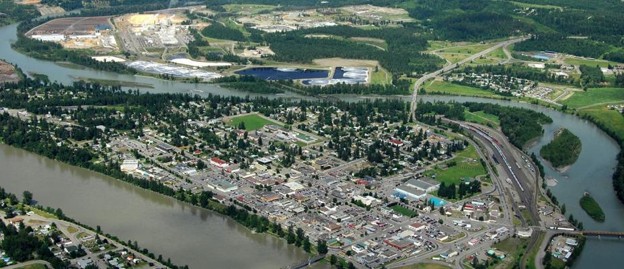
Quesnel has spent years preparing for an economic future less dependent on forestry. Yet major industry still accounts for more than half of the city’s municipal property tax revenues, and the loss of hundreds of manufacturing jobs has demonstrated how difficult economic transitions can be. The question is not whether Quesnel is working to diversify. It is whether those efforts are making the community less vulnerable to the next downturn.
For generations, forestry has been central to Quesnel’s economy and identity. The mills have provided steady employment, supported local businesses, contributed significantly to municipal revenues, and allowed families to build their lives here. That influence extends throughout the community, from the contractors who service industrial operations to the restaurants and retailers that depend on household spending.
In 2019, Tolko announced the permanent closure of its Quest Wood sawmill, affecting approximately 150 employees. Alongside the elimination of a permanent shift at West Fraser’s local sawmill, Quesnel faced the loss of approximately 210 jobs, according to then-mayor Bob Simpson.
For a former mill worker, the effects of that kind of disruption can extend well beyond the loss of a paycheque. Lower income may mean cutting back on household spending, postponing major purchases, and facing uncertainty about whether retraining or another local job can provide comparable stability. This experience illustrates why employment growth in another sector does not automatically replace the security, wages, and established skills associated with mill work.
The closures reinforced how closely Quesnel’s economic fortunes remain tied to an industry facing increasingly difficult conditions, including changing timber supplies, volatile markets, wildfires, and rising operating costs.
Yet the community has not been standing still. Since at least 2014, the city has pursued economic development and transition initiatives intended to strengthen existing industries, attract investment, and create new opportunities.
A Changing Workforce
Changes in Quesnel’s workforce offer one way of understanding how the local economy has evolved.
Between 2016 and 2021, the manufacturing labour force in the Quesnel census agglomeration, which includes the city and surrounding area, declined from 2,205 to 1,705 people. That represents a decrease of approximately 23 per cent.
Over the same period, the agriculture, forestry, fishing, and hunting category declined from 1,040 to 810 people, a reduction of roughly 22 per cent.
Other sectors experienced growth. Health care and social assistance, for example, increased from 1,110 to 1,245 people.
These figures require some context. Manufacturing includes industries beyond wood processing, while forestry is grouped with agriculture, fishing, and hunting. The figures represent people in the labour force rather than the number of jobs available. The 2021 Census was also conducted during the COVID-19 pandemic, which influenced employment patterns across the country.
Taken together, these figures suggest that Quesnel’s economy is changing, but they tell us less about whether those changes are creating meaningful opportunities for residents.
Someone who has spent years working in a sawmill may not be able to transition into a career in health care without additional education or training. The qualifications, wages, and career opportunities differ considerably between industries, meaning that employment growth in one sector does not necessarily compensate for losses in another.
Economic diversification must therefore create more than growth across different industries. It must provide realistic employment alternatives that allow residents to build financially stable futures in Quesnel.
The Municipal Finance Challenge
Employment is only one part of Quesnel’s reliance on major industry. Another, perhaps less visible, connection is the city’s dependence on industrial property taxes.
Over time, Quesnel has worked to reduce the proportion of municipal property taxes paid by major industry. Despite these efforts, the city’s 2026 financial plan shows that major industrial properties still contribute approximately $11.6 million, representing 52.3 per cent of municipal property taxation.
A declining share of industrial taxation does not necessarily mean the city is less dependent on industrial revenue. Changes in assessments and tax rates can shift the percentages without substantially reducing the financial consequences of another mill closure.
Even with reduced industrial tax revenues, the city would still need to maintain infrastructure and deliver essential services. Depending on the scale of the loss, residents could face higher property taxes, deferred infrastructure improvements, or changes to municipal services.
The City of Quesnel has recognized these risks. Its 2025 Annual Report identifies contingency planning for potential future tax shifts, while the city has extended its financial planning to a 20-year horizon. Its 2026 financial documents also acknowledge ongoing efforts to reduce the tax burden carried by major industry.
These are important measures, particularly for a municipality whose property tax revenues depend so heavily on a relatively small number of industrial properties. However, preparing financially for the potential loss of a major taxpayer is different from reducing the community’s underlying dependence on that revenue.
For residents, the question remains: how much industrial tax revenue could Quesnel afford to lose before the consequences were felt in municipal services, infrastructure, or household property taxes?
Diversification: From Plans to Results
Quesnel has invested considerable effort into identifying opportunities to strengthen and diversify its economy.
The city’s 2025–2029 Economic Development Strategy outlines priorities in business development, forestry innovation, agriculture, mining-related opportunities, and tourism. The strategy seeks to build on existing strengths while encouraging growth in other sectors.
The city has also pursued tourism promotion, business development, housing, and infrastructure improvements intended to support future growth and investment. Its Economic Development Strategy identifies earlier actions including the RV park at the former Public Works yard, updated relocation and visitor materials, participation in the Cariboo Chilcotin Coast tourism network, and a new Tourism Quesnel website.
These efforts are important, and their results may take years to become apparent. Attracting investment, establishing new industries, and supporting local businesses are long-term undertakings, particularly in smaller communities where economic opportunities are influenced by factors beyond municipal control.
Quesnel’s 2025 Annual Report identifies several accomplishments, including the completion of its economic development strategy, the launch of an online community profile, increased tourism website traffic, and more than 200 contributions to the strategy’s public engagement process.
These accomplishments demonstrate progress in planning, promotion, and community engagement. What they do not necessarily tell us is how many sustainable jobs have been created, how much private investment has been attracted, or whether local businesses are experiencing long-term growth.
The city’s strategy identifies indicators that could help answer those questions, including tourism website metrics, tourism-operator participation in itineraries, and visitor-related funds. Quesnel also maintains an economic development data platform with business and labour-market indicators. However, publicly available reporting does not yet establish how many permanent jobs, new businesses, or dollars in private investment have resulted from the strategy. Residents can see what the city has done, but they still need consistent baseline data and follow-up reporting to assess what those actions have achieved.
This limitation does not mean the initiatives have been unsuccessful. Many are still developing, and their economic benefits may not be immediately measurable. It does mean that future reporting should connect activity measures to outcomes: new employment, sustained investment, business survival and growth, and a local economy better able to withstand disruption.
Can Forestry Itself Be Part of the Answer?
Building a more diverse economy does not necessarily mean moving away from forestry.
Quesnel has considerable advantages in this sector, including an experienced workforce, established industrial infrastructure, transportation connections, and generations of knowledge in wood processing and forest management. These are strengths that can support new opportunities rather than simply represent an industry in decline.
Higher-value wood products, biomass utilization, and innovations in forest management could create additional economic activity while building on the skills and infrastructure already present in the region. For workers and businesses with longstanding ties to forestry, these opportunities may also provide more accessible pathways into new forms of economic activity.
The Three Rivers Community Forest offers another example of how the region is exploring different approaches to forest management. Developed through a partnership involving the City of Quesnel and neighbouring First Nations, the initiative creates opportunities for greater local participation in decisions about forest resources. In 2025, the organization hired a general manager and continued developing its operations.
These initiatives offer opportunities to adapt Quesnel’s forestry sector. However, diversifying within an industry is not necessarily the same as diversifying beyond it.
Developing new wood products or forest-based businesses may reduce reliance on particular markets or forms of production, but those activities can remain vulnerable to many of the same pressures affecting traditional forestry operations. Timber availability, wildfires, operating costs, and provincial forestry policies can influence both established and emerging businesses.
Forestry innovation may therefore contribute to a more resilient local economy without fully addressing the risks associated with depending so heavily on one sector.
Quesnel’s established expertise in forestry is an economic advantage. The challenge is to build sufficient strength in other sectors so that the community’s employment, investment, and municipal revenues are not all exposed to the same pressures.
Measuring What Matters
What would a more resilient Quesnel actually look like?
It would be a community where residents have access to diverse employment opportunities that provide financial stability and pathways for advancement. Local businesses would have the conditions necessary to establish themselves, grow, and contribute to the regional economy. Municipal finances would be better positioned to withstand the loss of a major industrial taxpayer without significant consequences for public services or other property owners.
Employment trends across industries can help show whether the local economy is becoming more diverse. Business growth and private investment can provide insight into whether new economic opportunities are taking hold. Changes in the municipal tax base can help demonstrate whether the city’s financial exposure to major industry is declining.
No single measure can capture the full picture, but together they would offer residents a clearer understanding of Quesnel’s progress.
The city’s economic development strategy already establishes priorities and identifies indicators for monitoring progress. An annual public assessment of employment trends, business development, private investment, and changes in the municipal tax base would provide residents with a more meaningful picture of whether Quesnel is becoming less vulnerable to industrial disruption.
Although economic transitions take time and remain influenced by provincial policy, private investment, and global markets, consistent public reporting would help distinguish meaningful progress from the activities intended to produce it.
Quesnel has recognized the challenges facing its traditional industries and taken meaningful steps to prepare for change. What remains less clear is how much those efforts have reduced the community’s exposure to future economic disruption.
The next major downturn will test more than the strength of Quesnel’s traditional industries. It will test whether the community has developed the employment opportunities, businesses, and financial stability needed to withstand another period of disruption.
Quesnel cannot control global lumber markets, provincial forestry policy, or every decision made by the companies operating within its boundaries. What it can do is establish a clearer understanding of its economic vulnerabilities, measure whether its efforts are reducing them, and make those findings available to the people whose futures depend on the results.
Sources
- Statistics Canada. 2016 Census Profile: Quesnel census agglomeration.
- Statistics Canada. 2021 Census of Population: Distribution of the employed labour force by industry sector, Quesnel (CA). 2021 Census labour-force data
- Legislative Assembly of British Columbia. Finance and Government Services Committee, June 19, 2019.
- City of Quesnel. 2025 Annual Report. Annual report
- City of Quesnel. Quesnel Economic Development Strategy 2025–2029. Strategy PDF
- City of Quesnel. Economic Development Data Platform: Quesnel CA. Data platform
- City of Quesnel. 2026 Financial Plan and Property Taxation Report.
- Three Rivers Community Forest. What Is a Community Forest? Community forest overview
- Photo: Shawn, “Quesnel, BC” (2009), via Wikimedia Commons, CC BY-SA 2.0. Cropped


Leave a Reply